Thursday, 29 December 2022
Wednesday, 28 December 2022
Critical power curves of professional riders (and how mine compares)
My Analysis
In the chart below you can see in the three red and pink lines the new data from Pedro L. Valenzuela et al, for the 10th, 75th and 90th percentiles of the 144 male riders. The blue symbols and the error bars show the range of W/kg values from Allen & Coggon for 'World Class' and 'Domestic Pro' categories.
It can be seen from the plot that the two sources of critical power data agree very well for 1-minute, 5-minute and 60-minute durations. For the 5-second duration, the Allen & Coggon data shows higher W/kg values than the data from Pedro L. Valenzuela. However, the author commented on Twitter, in reply to one of my tweets, highlighting that they had only 11 sprinters in their database as a possible explanation why his data for the 5-second critical power might seem to be relatively low.
Nevertheless, I would say that the two sources of data agree rather well.
My Power Curve versus the Pros
The dashed black curve in the chart above shows my own critical power curve, for comparison against the pros.
At the lower durations, less than a minute or so, my critical powers aren't too bad. In some cases, they actually exceed the worst pro riders (the 10th percentile pro riders). However, at the longer durations, my lack of aerobic fitness is clearly visible, with the pro riders having critical powers approximately 30-60% better than me. This is further illustrated in the graph below, which shows how much better, as a percentage, the pros are compared to me.
What I conclude from this is that my power over short durations is pretty good considering that I am, at best, a very mediocre amateur racer. However, the longer durations reveal my lack of aerobic capabilities.
This probably explains why I've been able to get and hold many local Strava KOMs during the last 5-10 years, over one hundred of them, mainly on segments lasting <2 minutes, whereas I've never won a bike race of any kind! All this suggests that I have a relatively good anaerobic work capacity (AWC). I will analyse my AWC as a next step - something I've never done before - and write a blog post to explain my findings.
My Power Curve versus other amatuers
Finally, I want to show quickly how my power curve compares to other amateurs, because I think this shows a broadly similar picture of my strengths and weaknesses.
The website intervals.icu provides an excellent and free set of analytical tools for your cycling data files that are stored on Strava. Furthermore, the power curve analysis page allows you to see how your critical power numbers compare to other athletes in the same demographic, showing you graphically where you sit on the 'bell-shaped curve'. For my 40-49 age range, that's a good-sized population of around 12,000 cyclists in that age range. The people using intervals.icu are likely to be fairly serious recreational riders and amateur riders, so that's also worth keeping in mind.
The pIot below shows that I'm at about the 80th percentile mark for my best 5-minute and 60-minute powers, but my critical powers for 1-minute and 5-second durations are much better, where I'm in the ~95th and ~98th percentiles respectively.
Again, this goes to show that my strengths are with the relatively short duration efforts.
References
1) Hunter Allen & Andrew Coggon 2010. Training and Racing with a Power Meter 2nd Edition
2) Valenzuela PL, Muriel X, van Erp T, Mateo-March M, Gandia-Soriano A, Zabala M, Lamberts RP, Lucia A, Barranco-Gil D, Pallarés JG. The Record Power Profile of Male Professional Cyclists: Normative Values Obtained From a Large Database. Int J Sports Physiol Perform. 2022 May 1;17(5):701-710. doi: 10.1123/ijspp.2021-0263. Epub 2022 Feb 21. PMID: 35193109.
Sunday, 18 September 2022
Using virtual elevation analysis to find the fastest bike
Tomorrow I will be racing a local cyclocross race.
I pre-rode the course today on my cyclocross bike. It's bone dry and very rough, and my feeling is that it would be quicker on my hardtail mountain bike, with its higher volume tyres.
I wanted to properly check which bike was faster though, and I decided to check this by performing a quick Chung method virtual elevation test on the CX bike, with it's new tyres, and compare the results against the MTB, which I had tested previously. The results, plotted above, show that the MTB is indeed fastest on the grass field that I did the testing on.
Why Chung testing?
Chung testing, also called virtual elevation (VE) testing, is a method for determining the performance of bicycle using its power meter. It's often used by time trialists and triathletes to determine improvements to their aerodynamic efficiency, which is characterised by the CdA metric. The method can, however, also be used to determine rolling resistance changes though, and I have performed off-road rolling resistance tests in the past using this techniques, which are documented here.
The use of the Chung method for this type of testing is that is allows one bike to be compared to another, to quickly determine the relative efficiency, regardless of whether that efficiency improvement is coming from rolling resistance, aerodynamics or weight.
The traditional way of doing an VE analysis is to iteratively adjust the parameters, either the CdA or the Crr (rolling resistance coefficient), usually using the Golden Cheetah software, until the VE profile becomes flat. When the VE profile is flat, you know that you have a combination of CdA and Crr that is representing the performance of the bike correctly.
The alternative method, which I have used here, is to keep those parameters (CdA, Crr and weight) fixed for the analyses for both bikes, then look at the relative flatness of the two VE profiles.
In the plot above, it's clear that Bike B, the cyclocross bike, has a rising VE profile relative to Bike A, the MTB, when using the same values for CdA, Crr and weight as used for the MTB. This rising VE profile means that the analysis 'thinks' Bike B should be climbing, because more power is needed to propel the bike than would be needed for a flat profile. This shows that Bike B, the CX bike, is slower on the grass field I tested them on.
The beauty of this method is that it doesn't care whether the benefit is coming from rolling resistance, aerodynamics or weight. Instead, it only shows the net results of changes to those three. Also, as with all Chung testing, there is no need to hold a fixed power, which is a method I often see athletes and journalists trying to perform a comparative test. The Chung method allows you to ride at whatever power you want, as long as it's reasonably similar for one test and another.
A few caveats
I should add a few caveats, because it wasn't an ideal test, performed in perfect back-to-back conditions. Firstly the two bikes were tested on different days, so potentially the ground conditions and wind conditions were different. Qualitatively though, the ground conditions were similar on both days and although I felt there was slightly less wind for Bike B, this should favour the Bike B apparent performance. Therefore, as Bike B is showing worse performance, it won't change the conclusion that Bike A is the best one to use.
Secondly, the two bikes had different power meters. This not ideal, and in a perfect world I would test the same PM on both bikes. However, I mitigated this potential bias by applying a 10W correction (10W reduction in power) to the powers from Bike B, based on comparative testing that I did previously (here and here). All results are shown with this correction applied. hence it would require a 16W correction for Bike B to be as fast as Bike A, and I don't think they are that far apart.
Finally, in a perfect world I would have done some repeats, like an A-B-A-B type test protocol. However, I didn't have time.
Friday, 8 July 2022
Barbell riser blocks for deadlifts
I read somewhere recently that when performing deadlifts, you should use a proper olympic barbell and plates, so that the bar is the appropriate height off the ground. Apparently if the bar is any lower than that, it puts excessive stress on your back.
I don't have an olympic barbell, and didn't want to spend >£100 on a new set of weights when the set I have is otherwise perfectly fine.
As you can see from the photo, I decided to instead to make a couple of riser blocks to raise my barbell to the appropriate height.Weight plates for Olympic bars are 450mm in diameter, apparently, meaning the centre of an Olympic bar will be half that, 225mm, off the ground. My barbell set, on the other hand, has weight plates that are 310mm diameter (155mm radius), which is a difference in radii of 70mm. I therefore needed to make my riser blocks 70mm in height.
I did this with some spare timber I had, an old fence post and some plywood sheet. I used an off-cut of my turbo trainer foam mat to add a bit of cushioning on top. So it was all done without having to buy any new materials, and it took only about an hour to build.
Wednesday, 29 June 2022
Testing MTB tyre rolling resistance using virtual elevation analysis
- I performed a repeat at only one pressure on the grass surface, whereas for the previous cyclocross tyre test, I did several off-road repeats.
- On the other hand, I did two road tests, before and after the off-road testing, to get a feel for the repeatability of my CdA estimate.
- There's no need to brake. Any braking would screw up the VE analysis.
- It's quiet and free from other riders or people getting in the way.
- I was able to ride a consistent line around the field each time.
- Finally, I sometimes use my MTB for cyclocross races, so I was anyway interested in the optimum MTB tyre pressures on grass.
Monday, 25 April 2022
Homemade 'cat ear' wind noise reduction devices
These type of wind noise devices have been around for some time. This article published about 10 years ago by James Huang on Bike Radar describes the original Cat Ears, which I think were the first wind noise reducing devices like this. The intended benefit of reducing wind noise is to enable the rider to better hear other sounds. Personally, I've often found it difficult to hear what my riding friends are saying due to wind noise, and so back in 2018 I was keen to get a pair.
Unfortunately, when I was looking to buy some of these a few years ago, the official Cat Ears weren't sold here in the UK, only in the US. Alternatives were available though, so I bought a pair of Wind Blox devices. These were good at reducing wind noise, but I didn't like how thick in profile they were. Instead of being a fluffy material, like Cat Ears, the Wind Blox devices are a foam filled wrap that had a thickness of about 1cm. The problem I found was that the arms of my cycling glasses didn't fit over the top of them, due to their bulk. I tried putting the arms underneath the straps instead, but then the noise-reducing effect didn't work. It seemed that they needed to be flush against my face to cut out the noise.
At that point, I decided that I'd try to make a pair of Cat Ear devices myself.
Homemade Cat Ears Mk.1
This was my first attempt. I made these out of pieces of black Lycra material from a pair of worn out cycling shorts, some Velcro strips, and a piece of black fluffy faux fur material bought from HobbyCraft. The fluffy material cost a few pounds for the smallest quantify I could get, which was a 10 x 100cm piece (far more than I needed) from one of their fabic rolls. The various pieces were glued together using contact adhesive.- Lycra material, cut from an old worn-our pair of cycling shorts.
- 3M 12mm Hook and Loop Tape.
- Fluffy material from Hobbycraft
- Impact adhesive.
Thursday, 31 March 2022
Quick and dirty cross-calibration of Stages and Power2Max power meters
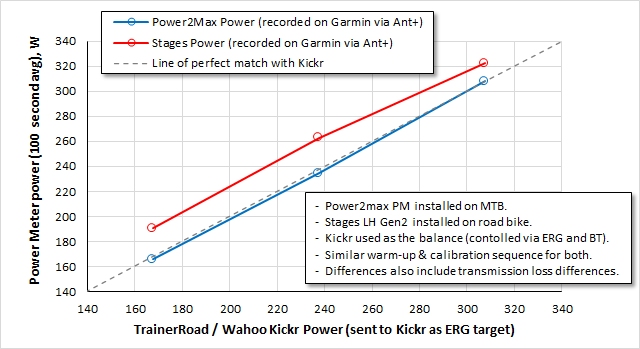
I will make this a short blog post, because the chart to the left speaks for itself.
Finally, after about 4 years of using exclusively single sided poer meters on my bikes (Stages left hand crank-based PMs), I decided to buy myself a dual-sided power meter. This new power meter was to be fitted onto my hardtail mountain bike, a Scott Scale, which until now never had a power meter installed on it.
After some research, I decided to by a Power2max NG-eco spider-based power meter. Strictly speaking, this measures total power, rather than both sides because the strain gauge measurements in the crank spider aren't able to differentiate whether the measured torque is coming from the left or the right side.
Before test riding my mountain bike with Power2Max power meter installed on it, I was keen to first check how its readings compared to the 2nd generation Stages power meter installed on my road bike, which I use for the majority of my training.
Unfortunately, it wasn't possible to fit both power meters on the same bike, because the the Stages Shimano 105 left hand crank arm wasn't compatible with the XTR crankset on my MTB, with the splines being different. Instead, I used a technique I've used previously (described here) to compare power meters, whereby I used my Wahoo Kickr trainer as the 'balance'.
The method involves testing one bike, then the other, on the Kickr, with the Kickr target (ERG) power profile controlled via an app using Bluetooth, in my case the TrainerRoad app. The actual power meter measurements are then recorded via ANT+ on my Garmin head unit.
The plot to the left shows the power meter readings versus time for the same Wahoo Kickr power profile.
It's clear that the Stages power meter reads significantly higher that the Wahoo Kickr power, whereas the Power2max power meter tracks very closely with the Wahoo Kickr. The plot at the top of the page shows the average power over 100 seconds for each interval. The Stages power meter reads between 15-25 Watts higher than the Kickr (5-14%), whereas the Power2max power meter is within 2-3 Watts.
There's no way to say for sure which power measurement is closest to 'the truth', but given that two power measurements match very well and the odd one out is a single-sided power meter, I think it's highly likely that the Stages power meter is the wrong one out of the three.
I think it's most likely that my left/right leg balance isn't 50/50, which is an assumption that the Stages power meter makes in it's calculation of total power from the left-hand power measurement. A leg/right balance of 55/45, for example, would result in a 10% over-estimation of power by the Stages.
Wednesday, 16 March 2022
Testing Schwalbe's Super Race Thunder Burts
A few months ago, Bicycle Rolling Resistance (BRR) tested the latest version of Schwalbe's Thunder Burt with the 2.25" Super Ground casing (see results here). It performed really well, narrowly beating the previous best mountain bike tyre, the 2.2" Continental Race King Protection (see results here).
As BRR said in it's conclusion: "The current generation has moved to Schwalbe's Super casings with a Super Ground and Super Race version available in several sizes. As the name suggests, the Super Race should be a bit faster than the Super Ground, while the Super Ground offers a bit more protection"
"...It looks like the Super Race version of the Thunder Burt is racking up quite a few votes and has a good chance of being tested in the near future as well."
Sadly though, the Super Race version of the Thunder Burt never made it to the top of the voting list and it expired from the list last month. I was a little disappointed by this, but I decided to buy a pair of those tyres anyway, particularly as I have an upcoming beach race in April that the Thunder Burt tread is perfect for. However, I wanted to test them first, to check how they performed against the Continental Race King Protection that I already own and have installed on the back of my MTB.
Equipment and test setup
I used my roller method for this testing, which I've described recently in previous blog posts.
The testing wasn't particularly straight-forward though, because my mountain bike doesn't have a power meter. I only have power meters on my road bike, my cyclocross/gravel bike and my time trial bike. Those are all Shimano Stages left hand crank-based power meters. My mountain bike has a SRAM GXP mountain bike chainset, so the chainset isn't at all compatible with those power meters.
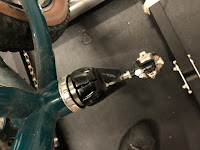
This meant the chainset axle was too long for the Stages 105 left-hand crank arm that I tried to fit on it. It did fit on the hollowtech tech splined axle, both having the same diameter and splines, but it left a gap between the crank arm and the bottom bracket cups. I needed a 5-6mm spacer or washer to fill the gap. I found that a spare set of axle cartridge bearings filled the gap perfectly (see photo above). This was a bodge, but it worked really well. As a result, I got my Shimano 105 power meter successfully working on the left hand side of my Shimano SLX chainset.
A bit more faffing was required to do the testing though: I had to remove my SKS mudguards, which rubbed on the large knobbly mountain bike tyres, and I changed the pedals to my good clipless SPDs too. All in all, it took a fair amount of time before I could get started.
I chose to do the testing with a lightweight (150g) butyl inner tube, just to save the time and mess associated with a tubeless set up. Since I was interested in which tyre was fastest, this approach was fine, because both tyres would be subject to the same additional losses from having the inner tube installed. Furthermore, doing the testing with an inner tube allowed a better comparison with the BRR data, which also used a butyl inner tube for their testing, albeit a heavier-weight inner tube.
Results
The plot below show how the the two tyres compare. I had enough time to repeat the testing for the Thunder Burts, after testing the Continental Race King, to confirm that Thunder Burts really does give lower CRR numbers. Since the two blocks of testing with the Thunder Burts were before and after the testing with the Race King, then I can be fairly confident the Thunder Burts are a better tyre, despite the imperfect repeatability seen in the plot below.
The differences aren't massive, and correspond to only 2-3 Watts at 25 kph, but it's a benefit worth having. Something to be noted is that the Thunder Burts were slightly larger than the Race King, at 2.35" width versus 2.2". In addition, the Thunder Burt was brand new, whereas the Race King was one or two years old and has some Stans sealant residue on the inside. This latter point might be a source of additional losses, I'm not sure, but in any case, the purpose of this exercise was to compare these two tyres ahead of my upcoming race, so these old and used tyres are the ones I would have chosen from anyway.
Monday, 14 March 2022
Do foam tyre inserts get smaller when tyres are inflated?
This surprising result got me thinking about the causes. Why don't the foam tyre inserts have an effect on rolling resistance? At low tyre pressures, the compression of the foam insert at the contact patch should generate hysteretic losses that manifest themselves as additional rolling resistance. Why is that not seen? It got me thinking.
One possible explanation, and one that I mentioned at the end of my previous post, was that the ends of the inserts were (unintentionally) not connected when I did the testing, so the foam insert was 'free floating' in the tyre cavity, rather than held tight against the rim. This is a plausible explanation for an absence of any effect at higher pressures. However, I would still expect the foam insert to get compressed at 15 psi, when the tyre drop (the squish) should have been enough to compress the foam insert.
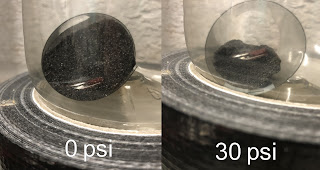
There is a second possible explanation for this observation, though, for the lack of a measurable effect of the tyre inserts. I remembered that when Vittoria launched their Air Liner Road tyre insert for road bikes, they explained that their inserts compress into the rim bead when the tyre is inflated, because the foam is closed-cell foam. The effect of the tyre pressure on the Vittoria Air Liner was demonstrated nicely in their video below:
This is the reason why the effect of the Vittoria Air Liner on tyre rolling resistance measurements was negligible when it was tested by Bicycle Rolling Resistance here. It might be the same reason why Aerocoach reached the same conclusion, but for the Tubolight Road insert in their rolling resistance testing here.